
Social, Spatial, and Racial Justice in Interpretation at African American History and Cultural Museums
Over the last two decades, geographers and other scholars have begun to study how African American history in the United States is misrepresented and disregarded relative to other historical narratives (for example Adams 2007; Alderman and Campbell 2008; Butler 2001; Hanna 2008; Inwood 2011; McKittrick 2006, 2011; Modlin 2008). Presented in museums and on plantation tours, roadside markers, and street names, the chattel slavery, Reconstruction, Jim Crow, redlining, the Civil Rights Movement and other key moments and people in African American history have been unevenly memorialized across the American cultural landscape. Museums are particularly important sites of historic preservation, documentation, and interpretation in light of research that Americans perceive museums to be among the most trustworthy sources of historical information, even over eyewitnesses or college history professors (Rosenzweig and Thelen 1998). Recognizing that museums are not politically neutral sites and do not operate in a vacuum, this new avenue of research seeks to understand how different types of history and cultural museums specializing in African American experiences change and adapt their narrative emphases in response to contemporary events.
Critical Historical Geographies of Slavery in the American South
In the more than 150 years since the end of the Civil War, Emancipation Proclamation, and 13th, 14th, and 15th Amendments to the U.S. Constitution that formally brought an end to chattel slavery, people in the United States have done much to downplay, sanitize, and outright forget both the history of slavery—despite its foundational role in the establishment of the U.S. political economy—and the life-altering damage that powerful white men, predominantly, inflicted upon millions of Africans and African Americans through a brutal system that lasted more than 200 years. Contributing to the process of whitewashing the histories and geographies of slavery have been the large absences of many academic disciplines to engage in critical research on chattel slavery until relatively recently. Since the 1960s, geographers have increasingly grappled with the discipline’s racist and imperialist past, engaging in “critical” studies that have advanced the discipline and added emphases on social justice, drawing upon diverse social theories such as Marxism, feminism, Critical Race Theory, and postmodernism. My dissertation built upon this scholarship in developing a critical historical geographic understanding of slavery and its legacy in the U.S., paying particular attention to the “Deep South” states of Alabama, Mississippi, and Louisiana. In the case of researching slavery, my dissertation argued that the ways in which people in the contemporary South (mis)remember the United States’ history are serious reflections on how contemporary issues of racism and white privilege operate in America. Taking a critical approach to historical geographic research of slavery is not merely an academic process but is inherently political. The dissertation engages with critical historical geographies of slavery by focusing primarily on counter narratives of slavery—“counter” in the sense that they stand in opposition to and correct whitewashed, dominant narratives that purport slavery was a mostly benign, patriarchal system. Further, it examines social and economic relations that operate to perpetuate these mythic perceptions of the United States’ chattel slavery system. The overarching research goal is to study the processes through which people form, operationalize, and can advance counter narratives of slavery.
Geographies of Holocaust Memory
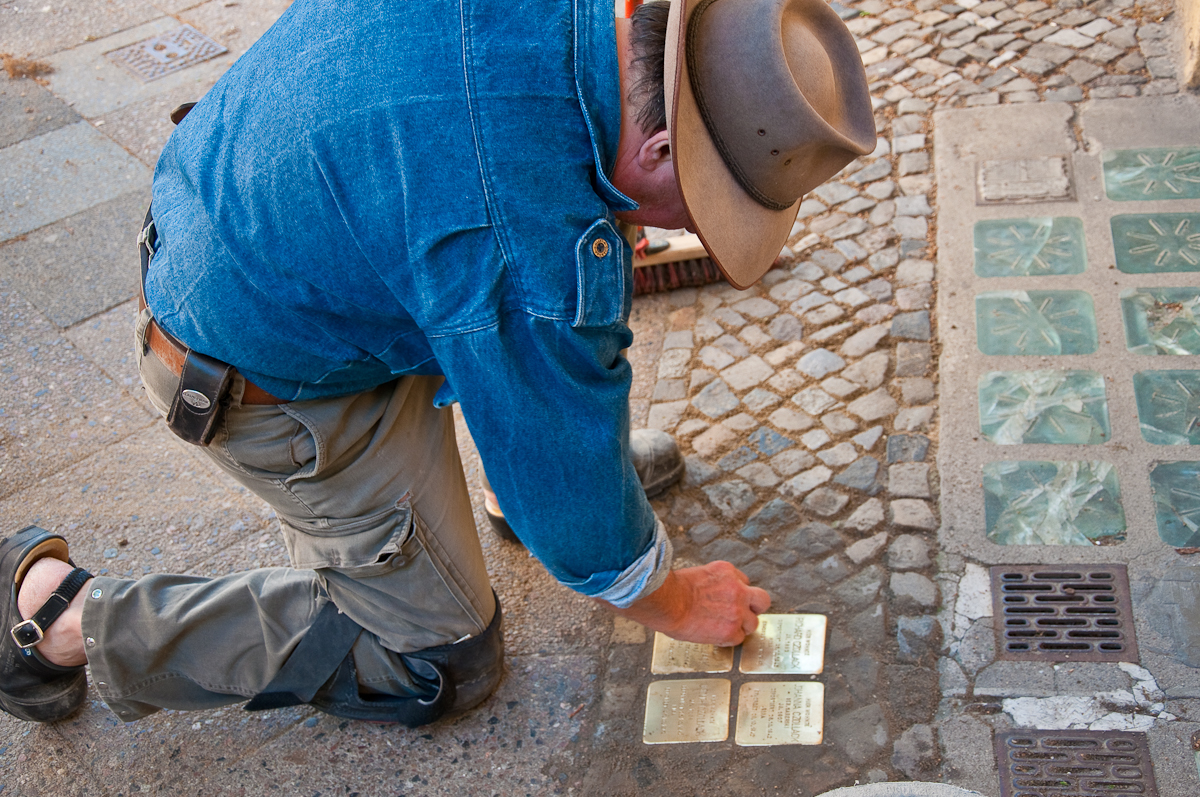
Stemming from my master’s research, studying and teaching about the Holocaust, genocide, the geographies of memory surrounding these tragic situations form the second intellectual strand of my academic interests. This line of research helped shape my early publication record, including an article co-authored with my master’s advisor on the Stolpersteine memorial project in Berlin and a book chapter on empathy and Holocaust memory in a book from Cambridge Scholars publishing.
 Map This!
One thought on “Research Interests & Projects”